
D.Pharma Admission Guide 2026 – Diploma in Pharmacy Complete Information
All India – Government & Private Pharmacy Diploma Colleges | Duration: 2 Years + 500 hrs Training | PCI Approved
Approved By: Pharmacy Council of India (PCI) & State Pharmacy Councils | Admission: State CET / Direct 12th Merit 2026 – NO NEET Required
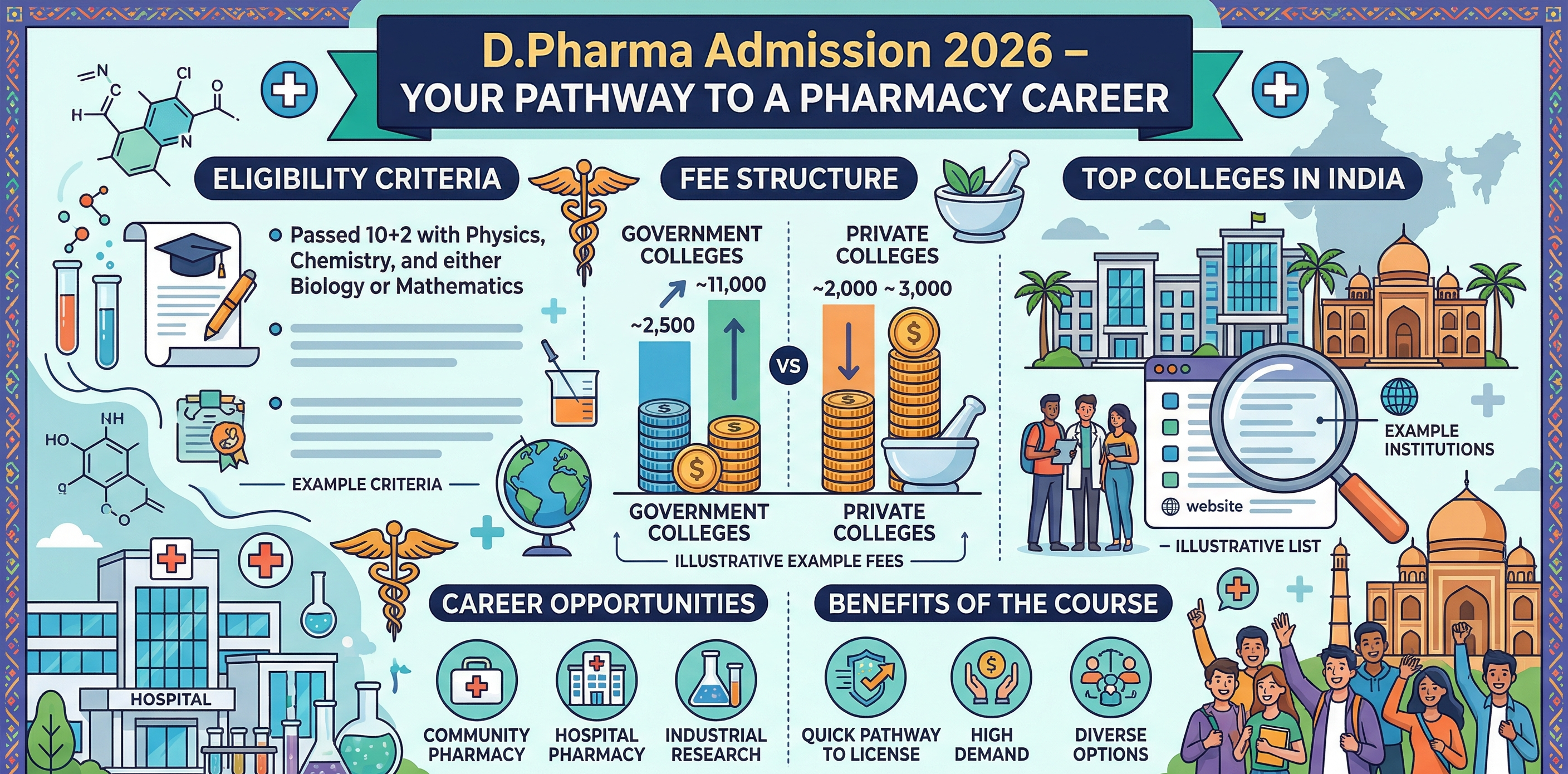
D.Pharma – India's Quickest Route to a Registered Pharmacist Career in 2 Years
About D.Pharma – Complete Admission Overview 2026
Diploma in Pharmacy (D.Pharma) is a 2-year PCI-approved diploma program that remains India's most accessible, fastest, and most affordable gateway into the pharmacy profession. Regulated by the Pharmacy Council of India (PCI) under the Pharmacy Act, 1948, D.Pharma is offered by over 5,000 government and private pharmacy colleges across India. After completing the 2-year academic program, students must undergo 500 hours of supervised practical training at a hospital or registered community pharmacy, after which they are eligible to register with their State Pharmacy Council as a Registered Pharmacist (R.Ph). This registration is the licence that legally allows a pharmacist to dispense medicines in India — making D.Pharma the minimum qualification for opening a medical store, working in hospital pharmacies, and serving government dispensaries. India's massive and growing pharmaceutical retail sector — with over 12 lakh registered pharmacies — ensures perpetual demand for D.Pharma-qualified professionals across every district of every state.
For students who have completed 10+2 with Physics and Chemistry — whether in Biology or Mathematics stream — D.Pharma offers an immediate, low-cost healthcare career pathway that requires neither NEET nor any competitive national entrance examination. The total cost of completing D.Pharma from a government college, including hostel, is often under ₹1 lakh, making it one of the most financially efficient healthcare qualifications in India. Beyond direct employment, D.Pharma serves as a springboard to the full B.Pharma degree via lateral entry into the 2nd year, allowing ambitious graduates to upgrade their qualifications without repeating Year 1. For a broader view of paramedical career options, our Paramedical Admission Guide provides a comprehensive comparison of all allied health programs available after 10+2.
🎯 2026 Key Fact: D.Pharma admission does NOT require NEET. Both PCB and PCM students are eligible. Admission via State CET or Direct 12th Merit. Government college total cost often under ₹1 lakh for 2 years. After D.Pharma: upgrade to B.Pharma 2nd year (lateral entry) available in most states. Free guidance: +91-7303848310.
Pharmacy Council of India (PCI) – Why PCI Approval is Non-Negotiable
The Pharmacy Council of India (PCI), established under the Pharmacy Act of 1948, is the only authority empowered to approve pharmacy education institutions in India. A D.Pharma degree from a non-PCI-approved college has zero legal value — the graduate cannot register as a pharmacist, cannot obtain a drug license, and cannot work in any legitimate pharmacy setting. Before applying to any D.Pharma college, always verify PCI approval on the official PCI website (pci.nic.in) and check if the college is affiliated to a recognised state technical board or university. In addition to PCI approval, candidates should verify AICTE recognition for private colleges, state pharmacy board affiliation for diploma programs, and availability of hospital/pharmacy for the mandatory 500-hour practical training. Every student deserves a genuine, legally valid pharmacy qualification — call +91-7303848310 to verify your target college's credentials for free.
Academic Curriculum – What You Study in D.Pharma
The D.Pharma curriculum, prescribed by PCI, is designed to produce practice-ready pharmacists in 2 years. Year 1 covers Pharmaceutics-I (basics of drug formulation and dosage forms), Pharmaceutical Chemistry-I (organic and inorganic chemistry of drugs), Pharmacognosy (study of plant-based and natural drugs), Biochemistry and Clinical Pathology, Human Anatomy and Physiology, and Health Education and Community Pharmacy. Year 2 advances into Pharmaceutics-II (advanced dosage form technology, suppositories, parenteral preparations), Pharmaceutical Chemistry-II (synthetic drugs and analysis), Pharmacology and Toxicology (drug action, adverse effects, clinical pharmacology), Pharmaceutical Jurisprudence (pharmacy law, drug regulations, PCI act), Drug Store and Business Management, and Hospital and Clinical Pharmacy (prescription reading, patient counselling, medication management in hospitals). The mandatory 500-hour practical training conducted post-examination provides real-world exposure in retail or hospital pharmacy settings, covering dispensing, inventory management, OTC counselling, and documentation practices. Students exploring broader healthcare options should also review our guides on MBBS admission, BDS admission, and AYUSH courses for comparison.
500-Hour Practical Training – The Bridge to Professional Practice
The 500-hour supervised practical training is a mandatory PCI requirement following the completion of the 2-year academic program. This training must be completed at a PCI-recognised hospital pharmacy (with minimum 100 beds) or a licensed retail pharmacy. During this period, trainees are supervised by a registered pharmacist and gain hands-on experience in prescription dispensing, drug interaction checking, patient counselling, stock management, compounding of medicines, hospital formulary management, and documentation of adverse drug reactions. Upon successful completion, the trainee receives a training certificate from the registered pharmacist or hospital pharmacy head, which is submitted along with the D.Pharma certificate to the State Pharmacy Council for registration. The quality and setting of the 500-hour training significantly impacts employment readiness — hospital-based training is generally considered superior to retail pharmacy training for career advancement purposes.
Location & College Selection Strategy for D.Pharma
India has over 5,000 PCI-approved D.Pharma colleges spanning government polytechnics, standalone pharmacy institutes, and pharmacy wings of multi-discipline colleges. The highest concentrations of quality government D.Pharma colleges are in Maharashtra, Karnataka, Andhra Pradesh, Telangana, Tamil Nadu, Gujarat, Uttar Pradesh, Rajasthan, and Madhya Pradesh. When evaluating a D.Pharma college, the most critical factors are PCI approval status (verify on pci.nic.in), state board/university affiliation, proximity to a recognised training hospital or pharmacy, faculty credentials (B.Pharma/M.Pharma qualified), lab infrastructure for practicals, and placement or training network in local pharmacies. Government colleges typically offer vastly superior value for money compared to private colleges, with fees 3–5 times lower and the same PCI-approved curriculum. Future Education provides free personalised D.Pharma college selection guidance by state and budget — call +91-7303848310 or visit our College Selection Guide.
After D.Pharma – Upgrade, Advance & Grow
D.Pharma is not a terminal qualification — it is the first step in a well-defined pharmacy career ladder. The most popular next step for D.Pharma graduates is B.Pharma lateral entry (direct 2nd year admission), which converts the diploma to a full 4-year degree in just 3 additional years. After B.Pharma, graduates can pursue M.Pharma via GPAT for specialised pharmaceutical research, formulation, quality assurance, and clinical pharmacy roles. The Pharm.D (Doctor of Pharmacy) post-baccalaureate program (3 years) is another advanced pathway for those seeking clinical pharmacist careers in tertiary hospitals. For entrepreneurially minded graduates, a registered retail pharmacy backed by a D.Pharma certificate and drug license offers a high-income, low-capital business model that is proven across India. For international pharmacy aspirations, completing B.Pharma after D.Pharma enables NABP licensure (USA), GPhC registration (UK), and Gulf DHA/MOH/HAAD exams for hospital pharmacy roles in UAE, Saudi Arabia, and Qatar. See our MBBS & Healthcare Abroad Guide for more international pathways.
State Pharmacy Council Registration – The Final Step
PCI / State Pharmacy Council Registration: After completing D.Pharma and the mandatory 500-hour training, every graduate must register with their State Pharmacy Council before legally practising pharmacy. Registration requires submission of D.Pharma certificate, training completion certificate, identity proof, and payment of registration fee. The resulting Registered Pharmacist (R.Ph) certificate is mandatory for drug license, employment in hospital/retail pharmacies, and government pharmacist recruitment. Confirm registration procedures with your state's pharmacy council. Pre-admission and post-completion guidance: +91-7303848310.
D.Pharma 2026 – Course Highlights at a Glance
| Full Course Name | Diploma in Pharmacy (D.Pharma / D.Pharm) |
|---|---|
| Common Name | D.Pharma / DPharm / Pharmacy Diploma |
| Duration | 2 Years academic + 500 hours supervised practical training |
| Type | Full-Time Diploma in Pharmacy Sciences |
| Approved By | Pharmacy Council of India (PCI) | State Technical Education Board | Respective State University |
| NEET Required? | NO – NEET is NOT required for D.Pharma |
| 10+2 Stream Eligible | PCB (Physics, Chemistry, Biology) OR PCM (Physics, Chemistry, Mathematics) |
| Minimum 12th Marks | 45% aggregate in PCB/PCM (General/EWS) | 40% for SC/ST/OBC |
| Minimum Age | 17 years as on 31 December 2026 |
| Admission Route | State CET (MHT-CET, KCET, AP EAMCET, UPCET, GUJCET) | Direct Merit (12th PCB/PCM) |
| Government College Fee | ₹10,000 – ₹40,000 per year (total 2-yr cost often under ₹1 lakh) |
| Private College Fee | ₹30,000 – ₹90,000 per year |
| Practical Training | 500 hours post-exam in recognised hospital/retail pharmacy |
| Post-Training Registration | State Pharmacy Council – Registered Pharmacist (R.Ph) Certificate |
| Approx Colleges in India | 5,000+ PCI Approved D.Pharma Colleges |
| Total Seats (Approx) | 2,00,000+ seats per year across India |
| Upgrade Pathway | Lateral entry to B.Pharma 2nd Year (available in most states) |
| Career Options | Retail Pharmacist, Hospital Pharmacist, Drug Inspector (Govt), Community Pharmacist, Medical Store Owner, Pharma Sales |
| Avg Starting Salary | ₹12,000 – ₹30,000/month (Govt pharmacist: ₹25,000–₹50,000/month) |
| Entrepreneurship Option | Open own retail pharmacy (medical store) with drug license after R.Ph registration |
| Helpline (Future Education) | +91-7303848310 | [email protected] |
Pharmacy Diploma & Degree Courses in India 2026 – Overview
| Course | Level | Duration | Seats (Approx) | Admission Route |
|---|---|---|---|---|
| D.Pharma ⭐ | Diploma | 2 Years + 500 hrs | 2,00,000+ | State CET / Direct Merit |
| B.Pharma | UG Degree | 4 Years | ~1,00,000+ | State CET / JEE / Direct Merit |
| Pharm.D (UG) | UG Doctorate | 6 Years | ~10,000+ | State CET / PCI Merit |
| M.Pharma | PG Degree | 2 Years | ~50,000+ | GPAT → Counselling |
| Pharm.D (Post-B.Pharma) | PG Doctorate | 3 Years | ~5,000+ | Merit / University Entrance |
| PhD Pharmaceutical Sciences | Doctorate | 3–5 Years | Variable | CSIR-NET / University Entrance |
All Pharmacy & Allied Paramedical Courses – Diploma, UG, PG & Certificate
D.Pharma is just the beginning. Explore all pharmacy, nursing, and allied health programs below. Each card covers admission, fee, and career details with direct enquiry links.
Diploma & Undergraduate Pharmacy Programs
D.Pharma
Diploma in Pharmacy
- Duration: 2 Years + 500 hrs
- Route: State CET / Direct Merit
- Fee: ₹10K–₹90K/yr
B.Pharma
Bachelor of Pharmacy
- Duration: 4 Years
- D.Pharma Lateral Entry: 2nd Year
- Fee: ₹15K–₹2L/yr
Pharm.D
Doctor of Pharmacy (6-Year UG)
- Duration: 6 Years
- Route: State CET / PCI Merit
- Clinical Pharmacist Role
B.Sc Nursing
Bachelor of Science in Nursing
- Duration: 4 Years
- Route: NEET / State Merit
- Fee: ₹10K–₹2.5L/yr
BMLT
B.Sc Medical Lab Technology
- Duration: 3 Yrs + 1 Yr Intern
- Route: State Merit / Direct
- Fee: ₹30K–₹1L/yr
GNM / ANM
General Nursing & Midwifery
- GNM: 3.5 Years | ANM: 2 Yrs
- INC Approved
- Fee: ₹10K–₹80K/yr
Postgraduate (PG) Pharmacy & Advanced Programs
M.Pharma
8+ Pharmaceutical Specialities
- Duration: 2 Years
- Route: GPAT → Counselling
- AICTE Stipend ₹12,400/mo for GPAT holders
Pharm.D (Post-B.Pharma)
Clinical Doctor of Pharmacy
- Duration: 3 Years (after B.Pharma)
- Hospital Clinical Pharmacist Role
- Route: PCI / University Merit
MBA – Pharma Management
Healthcare Leadership
- Duration: 2 Years
- Route: CAT / MAT / NMAT
- Ideal after B.Pharma
PGDCR
PG Diploma – Clinical Research
- Duration: 1 Year
- Available after D.Pharma / B.Pharma
- CRO / Pharma Industry Roles
PhD Pharmaceutical Sciences
Doctoral Research
- Duration: 3–5 Years
- Route: CSIR-NET / University Entrance
- Research / Faculty Careers
Quick Enquiry
Request a callback
Certificate & Short-Term Pharmacy Programs
Certificate in Regulatory Affairs
Drug Regulation & Compliance
- Duration: 3–6 Months
- Available after D.Pharma / B.Pharma
- CDSCO / FDA compliance roles
Certificate in Drug Store Management
Retail Pharmacy Operations
- Duration: 3–6 Months
- Ideal for Medical Store Owners
- Inventory, billing, compliance
D.Pharma Admission Process 2026 – Step by Step
D.Pharma admissions across India follow two main routes: the State CET route for government and top private PCI-approved colleges, and the Direct Merit route for private diploma colleges admitting on the basis of 10+2 PCB/PCM marks. NEET is not required under any circumstances. Both PCB and PCM 10+2 students are fully eligible.
Complete 10+2 with PCB or PCM
Minimum 45% aggregate in Physics, Chemistry, Biology or Mathematics. English mandatory. No NEET required. Check paramedical eligibility guide.
Appear for State Pharmacy / Technical CET
MHT-CET (Maharashtra), KCET (Karnataka), AP EAMCET (Andhra Pradesh), TS EAMCET (Telangana), UPCET (UP), GUJCET (Gujarat), WBJEE (West Bengal). Many states do not conduct separate pharmacy exams — 12th merit is sufficient.
Register on State Counselling Portal
After 12th results / CET results, register on the state pharmacy or technical education counselling portal. Upload documents and fill the application. Download our document checklist.
Choice Filling & Seat Allotment
Fill preferred PCI-approved D.Pharma colleges in order. Prioritise government colleges for lower fees. Verify PCI approval before filling. Call +91-7303848310 for expert choice-filling guidance.
Document Verification
Report with 10th marksheet, 12th marksheet, transfer certificate, category/domicile certificate, CET scorecard (if applicable), recent passport photographs, and medical fitness certificate. Verify PCI approval letter of the college at reporting.
Fee Payment, Joining & Practical Training
Pay semester/annual fee. Classes begin August–September 2026. After 2-year academics: complete 500 hrs practical training, then register with State Pharmacy Council for R.Ph certificate.
⚡ Direct Admission (Private Colleges): Hundreds of private PCI-approved D.Pharma colleges across India admit directly on the basis of 12th PCB/PCM marks without any entrance exam. Fees range from ₹30,000–₹90,000/year. Call +91-7303848310 for a verified list of PCI-approved private D.Pharma colleges in your state.
Eligibility Criteria – D.Pharma Admission 2026
Academic Qualification
- 10+2 with Physics & Chemistry as compulsory subjects
- Third subject: Biology OR Mathematics (both PCB and PCM accepted)
- General/EWS: Minimum 45% aggregate in PCB/PCM
- SC/ST/OBC: Minimum 40% aggregate in PCB/PCM
- English must be one of the 10+2 subjects
- Any recognised board – CBSE, ICSE, State Boards
Entrance & Age Requirements
- NEET: NOT required for D.Pharma under any circumstances
- State CET required for government pharmacy polytechnic seats
- Many private colleges: direct 12th merit; no entrance exam
- Minimum age: 17 years as on 31 December 2026
- No maximum age limit prescribed by PCI for D.Pharma
- Working professionals / mature students also eligible
State Domicile & Special Categories
- State domicile required for state government college quota seats
- SC/ST/OBC reservation as per state government norms
- EWS reservation (10%) available in most states
- PwD horizontal reservation as per state policy
- Sportsperson / NCC / Ex-servicemen supernumerary seats in some states
- NRI/Management quota in private colleges; higher fees applicable
D.Pharma Fee Structure 2026 – Government vs Private Complete Breakdown
| College Type / Fee Component | Annual Fee Range | Notes |
|---|---|---|
| State Govt Pharmacy Polytechnic / College | ₹10,000 – ₹40,000/year | Heavily subsidised; state domicile required for govt quota |
| Aided / Semi-Government D.Pharma College | ₹20,000 – ₹55,000/year | Partially government-funded; lower fees than fully private |
| Private PCI-Approved D.Pharma Colleges (Mid-Range) | ₹30,000 – ₹70,000/year | Wide availability; verify PCI approval before applying |
| Private Premium D.Pharma Colleges | ₹60,000 – ₹90,000/year | Better infrastructure; larger hospital for practical training |
| One-Time Admission / Caution Deposit | ₹3,000 – ₹15,000 | Caution money refundable; admission fee non-refundable |
| Hostel + Mess (Annual) | ₹25,000 – ₹70,000/year | Available in most colleges; varies by city |
| Exam / Practical / Lab Fee (Annual) | ₹3,000 – ₹10,000/year | Pharmaceutical lab, university exam fee |
| Total 2-Year Cost (Govt College) | ~₹50,000 – ₹1,20,000 | Including hostel; most affordable healthcare qualification |
| Total 2-Year Cost (Private College) | ~₹1,00,000 – ₹2,50,000 | All inclusive estimate for mid-range private D.Pharma colleges |
*Fees subject to state fee regulatory committee revision for 2026-27. Always confirm from official college website or PCI approved college list before paying.
Education Loan for D.Pharma
Education loans for D.Pharma are available from SBI, Canara Bank, Bank of Baroda, and Vidya Lakshmi portal for PCI-approved diploma programs. Since D.Pharma total cost is relatively low, personal loans or student credit cards are also viable. Free loan guidance: +91-7303848310.
Education Loan Guide 2026Scholarships for D.Pharma
SC/ST/OBC/EWS candidates can apply for state post-matric scholarships and NSP portal-based fee waivers covering D.Pharma tuition. Central Sector Scholarship is also available for eligible candidates with family income below ₹8 lakh per annum. Apply on the National Scholarship Portal (scholarships.gov.in).
Compare All Course Fees 2026D.Pharma Seat Matrix 2026 – Quota-Wise & State-Wise
| Institute / Quota Type | Approx Seats | Admission Authority | Eligibility |
|---|---|---|---|
| State Govt Pharmacy Polytechnics / Colleges | ~40,000+ | State Tech Education / Pharmacy Counselling | State CET / 12th Merit; Domicile required |
| Aided / Semi-Govt D.Pharma Colleges | ~20,000+ | State Authority / College | State CET / 12th Merit |
| Private PCI-Approved D.Pharma Colleges | ~1,30,000+ | State CET / College Management | 12th PCB/PCM 45%+ / CET |
| SC/ST/OBC State Reservation | As per state reservation policy | State Counselling Authority | Valid category certificate + domicile |
| EWS Reservation | 10% horizontal in most states | State Counselling | EWS certificate; family income < ₹8 lakh |
| NRI / Management Quota (Private) | ~15% of private college intake | College Management | 12th PCB/PCM 45%+ ; higher fee applicable |
| Total D.Pharma Seats (India Approx) | ~2,00,000+ | PCI + State Authorities | 10+2 PCB/PCM + State CET / Merit |
D.Pharma State CET Cutoff 2026 – State-Wise Analysis
MHT-CET Pharmacy (Maharashtra Govt)
75–95 PercentileGovernment polytechnic D.Pharma seats in Mumbai, Pune, Nagpur have higher demand. Private colleges accessible at 40–65 percentile or direct merit basis.
KCET Pharmacy (Karnataka Govt)
Rank < 20,000Government pharmacy diploma seats in Karnataka have competitive demand. Private college D.Pharma seats open at rank 20,000–80,000 or direct 12th merit.
Direct / 12th Merit (Private Colleges)
45–55% in 12thMajority of private PCI-approved D.Pharma colleges across all states admit on 12th PCB/PCM marks alone. No entrance exam. Minimum 45% required.
State-Wise D.Pharma Admission Cutoff & Route Overview 2026
| State | Entrance Exam | Govt College Cutoff (Gen) | Private College Route | Approx D.Pharma Seats |
|---|---|---|---|---|
| Maharashtra | MHT-CET | 75+ Percentile | Direct 12th Merit / CET 40–60%ile | ~20,000 |
| Karnataka | KCET | Rank <20,000 | Direct 12th Merit / KCET 20K–80K | ~15,000 |
| Andhra Pradesh | AP EAMCET | Rank <8,000 | Direct 12th Merit | ~12,000 |
| Uttar Pradesh | UPCET / JEECUP | Rank <5,000 | Direct 12th Merit | ~18,000 |
| Gujarat | GUJCET | Rank <3,000 | Direct 12th Merit / GUJCET | ~10,000 |
| Tamil Nadu | TNEA / Merit | 12th PCB 60%+ | Direct 12th Merit | ~12,000 |
| Rajasthan | State Merit | 12th PCB/PCM 55%+ | Direct 12th Merit | ~8,000 |
*Approximate data based on 2024–25 trends. 2026 cutoffs depend on applicant count and seat matrix. Verify from official state pharmacy counselling portals after 12th results.
⚡ Cutoff Insight 2026: D.Pharma is the most accessible pharmacy qualification in India. Even if you miss government college cut-off, over 5,000 private PCI-approved colleges admit on 12th merit alone. Minimum 45% in PCB/PCM is usually sufficient for direct private college admission. Call +91-7303848310 for verified, state-wise college shortlisting with PCI approval confirmation.
Top D.Pharma Colleges in India 2026 – Government & PCI Approved
| College Name | Type | State | Approx Fee/yr |
|---|---|---|---|
| Govt. College of Pharmacy, Mumbai | Govt | Maharashtra | ~₹12,000 |
| Govt. Polytechnic (Pharmacy), Pune | Govt Polytechnic | Maharashtra | ~₹15,000 |
| Govt. Pharmacy College, Bangalore | Govt | Karnataka | ~₹18,000 |
| Govt. Pharmacy College, Hyderabad | Govt | Telangana | ~₹14,000 |
| Govt. Pharmacy College, Vijaywada | Govt | Andhra Pradesh | ~₹12,000 |
| Govt. Pharmacy College, Lucknow | Govt | Uttar Pradesh | ~₹15,000 |
| Panjab University Chandigarh – Pharm Dept | Central Univ | Chandigarh | ~₹20,000 |
| Govt. College of Pharmacy, Jaipur | Govt | Rajasthan | ~₹12,000 |
What Makes a Great D.Pharma College?
- PCI Approval: Mandatory – check pci.nic.in before applying to any college
- State Board Affiliation: Diploma must be from a recognised state technical board
- Training Hospital/Pharmacy: College must have tie-up with a recognised hospital or retail pharmacy for 500-hr training
- Lab Infrastructure: Pharmaceutics lab, chemistry lab, pharmacognosy lab, pharmacology lab with proper equipment
- Faculty: Minimum B.Pharma/M.Pharma qualified teaching staff per PCI norms
- Placement: Track record of students placed in hospital pharmacies or pharma companies
- Location: Proximity to pharmaceutical industry zones boosts training and placement
Career Scope After D.Pharma 2026 – Jobs, Business & Upgrade Paths
Retail Pharmacist / Medical Store
After R.Ph registration, open your own medical store or work as pharmacist in retail pharmacy chains (Apollo Pharmacy, MedPlus, Wellness Forever, Jan Aushadhi). Starting salary: ₹12,000–₹25,000/month. Own store income: ₹40,000–₹1,50,000+/month in Tier 2/3 cities.
Hospital Pharmacy
Staff pharmacist in government hospitals (PHC, CHC, District Hospital), ESIC dispensaries, Railway Medical Services, and private hospital pharmacies. Pay: ₹18,000–₹40,000/month. Government hospital pharmacist posts recruited via state PSCs and ESIC/CGHS.
Government Pharmacist Jobs
Pharmacist Grade-II posts in state health departments, ESIC, Railways, CGHS, Defence (AFMS), and municipal corporations. Recruited via state PSCs, SSC, and departmental exams. Pay: ₹25,000–₹50,000/month with all government benefits, pension, and job security.
Pharmaceutical Sales Representative
Medical representative / pharma sales roles in leading companies including Sun Pharma, Cipla, Abbott, Lupin, and Mankind Pharma. Salary: ₹15,000–₹35,000/month + incentives + travel allowance. High growth role with strong performance-linked bonuses.
Upgrade to B.Pharma (Lateral Entry)
D.Pharma holders can enter B.Pharma 2nd year directly in most states, completing the degree in 3 additional years. After B.Pharma, M.Pharma via GPAT unlocks pharmaceutical R&D, quality assurance, regulatory affairs, and international pharmacy careers. See our B.Pharma Guide.
Jan Aushadhi & Community Pharmacy
Pradhan Mantri Bharatiya Janaushadhi Pariyojana (PMBJP) Jan Aushadhi stores require a registered pharmacist. D.Pharma with R.Ph certificate qualifies. Monthly procurement support from GoI. Excellent entrepreneurial opportunity in rural and semi-urban India with government backing.
Frequently Asked Questions – D.Pharma Admission 2026
Ready to Secure Your D.Pharma Seat in 2026?
Expert guidance on government vs private college selection, state CET strategy, PCI approval verification, lateral entry to B.Pharma & education loan — 100% free.
Compare Pharmacy Courses & Quick Tools
D.Pharma vs Other Pharmacy & Healthcare Courses 2026 – Complete Comparison
| Course | Duration | Total Cost | NEET Req. | Upgrade Path | Career Entry |
|---|---|---|---|---|---|
| D.Pharma ⭐ | 2 Yrs + 500 hrs | ₹50K–₹2.5L (total) | No | B.Pharma 2nd yr | Fastest |
| B.Pharma | 4 Years | ₹1L–₹8L (total) | No | M.Pharma via GPAT | Good |
| Pharm.D (UG) | 6 Years | ₹3L–₹12L (total) | No | M.Pharma / Clinical | Clinical |
| GNM Nursing | 3.5 Years | ₹50K–₹3L (total) | No | Post-Basic B.Sc Nursing | Good |
| B.Sc Nursing | 4 Years | ₹50K–₹10L (total) | Govt Only | M.Sc Nursing | Excellent |
| MBBS | 5.5 Years | ₹50K–₹1.5 Cr (total) | Yes – Mandatory | MD/MS/PG Diploma | Doctor Career |
Detailed Course Comparisons
D.Pharma vs B.Pharma
D.Pharma is the fastest, cheapest pharmacy entry in 2 years — ideal for quick employment or opening a medical store. B.Pharma is a 4-year degree unlocking pharmaceutical industry, government regulatory, and international pharmacy careers. D.Pharma holders can upgrade to B.Pharma via lateral entry into Year 2, making both qualifications complementary rather than competing.
View B.Pharma GuideD.Pharma vs GNM Nursing
GNM (3.5 years) trains hospital nurses while D.Pharma (2 years) trains pharmacists. D.Pharma is shorter, cheaper, and allows entrepreneurship (own pharmacy). GNM graduates work in hospitals. Both are excellent non-NEET healthcare careers. For PCM students, D.Pharma is available while GNM typically requires PCB.
View Paramedical GuideD.Pharma vs MBBS
MBBS requires NEET 550+ and 5.5 years, costing ₹50K–₹1.5 Cr total. D.Pharma requires only 45% in 12th, no NEET, 2 years, total cost under ₹2.5L. For students who couldn't crack NEET, D.Pharma offers a legitimate, respected healthcare career with quick employment and entrepreneurship potential.
View MBBS GuideD.Pharma vs AYUSH (BAMS/BHMS)
AYUSH courses require NEET and 5.5 years, producing Ayurveda/Homoeopathy doctors. D.Pharma needs only 2 years and no NEET. For students prioritising quick, cost-effective healthcare employment without NEET pressure, D.Pharma is the superior strategic choice. AYUSH is better for those committed to traditional medicine.
View AYUSH GuideQuick Tools & Resources
NEET College Predictor
Know your medical college chances
Marks vs Rank 2026
Convert NEET score to AIR
Counselling Guide 2026
State & AIQ step-by-step guide
Category Cutoffs 2026
Gen / OBC / SC / ST cutoffs
Education Loan Guide
SBI, HDFC, Avanse – free help
Document Checklist
Everything needed at reporting
Personalised Counselling
1-on-1 expert session – free
